Doctor of Ministry
Leadership and Research
Counting the Cost
Affording the D.Min.
Thanks to the generosity of our donors, we are able to reduce the base cost for all Doctor of Ministry students to $525 per credit hour enrolled.
-
100%
Of McAfee students benefit from the McAfee Tuition Grant to reduce the cost of their school of theology program.
Program Overview
The Doctor of Ministry degree is a three-to-four-year, 32-hour degree program and is the highest professional degree offered by a theological school.
Students remain in their fields of service for the entire program, coming to the Atlanta campus for classes for just one week each summer for three years.
The McAfee Doctor of Ministry Degree program was developed to help those seeking to enhance their ministry by providing the level of knowledge, theoretical clarity, and competence of practice commensurate with the highest earned degree for the profession and practice of ministry. The D.Min. will help you further your skills in ministry and provide you with the kind of learning experience that you will value throughout your lifetime.


Doctor of Minsitry
Example Courses
The D.Min. at McAfee has been recognized for its high academic standards, strong research contributions, the diversity of its faculty, and the quality of the projects completed by its graduates.
Emphasizing an effective partnership between students, their ministry contexts, and the School with a strong focus on the practice of ministry, the core areas of focus include: (1) Biblical Scholarship, (2) Cultural Context, (3) Holistic Practical Theology, (4) Spiritual Maturity, (5) Integration of Leadership and Research, and (6) Effective Communication.

Biblical/Theological Foundations for Ministry
This will focus on recent methodologies in biblical exegesis and ministry-oriented themes in contemporary theology as participants reflect on pastoral issues and hermeneutical moves from biblical texts.
The Practice of Ministry
This course will deepen the student’s understanding and practice of a variety of core skills and meta-skills that are essential for all types of ministries. Students will make changes to improve their ministry and assess their strengths and weaknesses in each area.
Contextual Ministry and Culture Today
This course will study the dynamics between congregations/organizations as systems within which ministry occurs and the cultural, community, and local environments which impact strategies for mission, evangelism, and service. Students will complete analyses of their community context, interpretations of the impact of cultural change on ministry, and explore the role of organizational identity in adapting to changing environments.
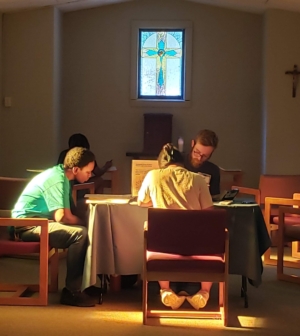
Spiritual Practices in the Life of the Church
This seminar focuses on classic spiritual practices of the Christian tradition, with particular attention to spiritual direction, a form of spiritual guidance in which one person serves as a companion and experienced guide to another person or group that is seeking to discern where God is actively present in their lives and how to respond faithfully to that Presence.

Coaching Individuals, Groups, and Congregations Toward Spiritual Growth
This seminar focuses on teaching ministers to model and coach the informed and intentional practice of listening to God and growing spiritually. The human sciences and theological disciplines will be explored for models of the spiritual life and of the spiritual world that can enhance the understanding of one’s own spiritual life and the practice of spiritual guidance through coaching.

Spirituality and Vocation
In this course, students develop their own spiritual and vocational discernment to inform their research identity throughout the Doctor of Ministry program. It is the first of three courses in Mentoring and Advanced Research Integration.

Clarity and Context
In this course, students identify, understand, and focus their community context for the Doctor of Ministry project thesis. It is the second of three courses in Mentoring and Advanced Research Integration. The course is organized into three primary themes. First, mentoring through coaching to interconnect a student’s vocational ‘why’ with the ‘who’ of a particular community in their project. Second, to introduce contextual adeptness in our own lives and the life of a community to further justice and shalom in the life of the world. Third, to advance research through clarifying a ministry context, developing an initial thesis proposal and an introduction to methodology.

Specialization and Integration
In this course, students specialize, integrate, and develop their Project Thesis Proposal. It is the third of three courses in Mentoring and Advanced Research Integration.

Mentoring through Spiritual Direction and Coaching
A unique feature of the D.Min. degree is pairing students with both a spiritual director and a ministry coach throughout their time in the program. Spiritual Directors and Ministry Coaches guide students in exploring their ‘why’ for doctoral studies in ministry, interconnecting a student’s vocational ‘why’ with the ‘who’ of a particular community in their project, and reflecting upon how their D.Min. experience, particularly their project, relates to their sense of calling, vocation, relationship with God.
What is a D.Min.?
The Doctor of Ministry degree is a three-to-four-year, 32-hour degree program and is the highest professional degree offered by a theological school.